

Before You Open Every Box: A Receiving Checklist for Branded Merchandise Deliveries in Canada
Before You Open Every Box: A Receiving Checklist for Branded Merchandise Deliveries in Canada
Before colleagues start opening a branded merchandise delivery, count the cartons, photograph their condition, and find the order documents. Once mugs, cables and gift boxes are separated from their shipping cartons, it becomes harder to explain exactly what arrived and where a discrepancy was found.
For Canadian marketing, procurement and office operations teams receiving a completed bulk order at one workplace, the useful distinction is between goods that have arrived and goods ready for internal release. This branded merchandise receiving checklist follows that handoff: reconcile the shipment, check the agreed details, document exceptions, and give the internal owner a quantity they can rely on.
Give one receiver the order record
Name a receiver and a backup before the delivery arrives. Give them the approved purchase order or quote confirmation, packing list when available, expected carton count, tracking references, and supplier contact. Confirm the workplace’s receiving hours and where unopened goods should wait. For a late-November or December delivery, tell reception who takes over if the usual receiver is absent.
The receiver needs the documents for this completed order, not a generic catalogue description. Keep the quoted SKU, selected colour, ordered quantity, included components, packaging and final approved imprint reference together. Their task is to compare delivery with those decisions, not redesign the order.
York University’s receiving procedure provides a Canadian institutional example: check the packing slip against the shipment, contact the vendor about discrepancies, and retain the receiving documents. Its payment and retention rules are specific to York; the practical reconciliation approach is useful more broadly. 1
Agree who can decide an exception and authorize internal release. Reception can record arrival without being asked to judge logo placement or an unfamiliar electrical accessory.
Record carton condition at the handoff
Count the cartons physically present and compare their labels with the shipment reference. If labels show a numbered sequence, record the numbers received rather than writing only “several boxes.” Note the arrival date, time, carrier and receiver.
Photograph readable labels and any crushed corners, punctures, wet areas or open seams before unpacking. Include an overall view and a closer view of the affected area. Keep the photos connected to the carton identifier in your receiving record.
Follow your organization’s instructions for delivery paperwork. Keep carrier handoff separate from your internal quality review: do not record checks that have not happened. This checklist does not establish the legal effect of a signature or a universal rule for accepting or refusing freight; follow the applicable contract and carrier instructions.
Reconcile cartons, units and complete sets separately
Use one worksheet or shared record with an entry for each SKU and colour. Capture the expected quantity, actual quantity accounted for, counting basis, discrepancies, quantity on hold, and quantity authorized for release. Keep carton numbers beside the relevant entries.
A packing list states what was shipped; it should not silently become your count of what was received. Distinguish physically counted units from quantities read from sealed-pack labels. If some contents remain unchecked, identify that limitation instead of marking the whole order fully verified.
Also state the unit of purchase. A carton, an individual mug and a two-mug set are different counts. For an order invoiced as sets, record complete sets separately from loose components. If a set lacks one piece, preserve that exception rather than converting the remaining pieces into a usable-set quantity.
Open cartons in a controlled sequence and keep contents associated with their original labels until reconciliation is finished. Avoid mixing colours or moving goods to departmental desks while the count is still underway.
Check the parts that make each item usable
Use the quoted contents to guide the receiving check. Category pages help organize the checklist, but the exact order identifies what should be present. Multi-part items in Food Containers & Utensils need a different check from soft-sided products in Lunch Bags & Coolers.
Ceramic items and boxed writing sets
The Totem Custom Mug Set contains two 12 oz ceramic mugs in a kraft mailer box. Check both mugs and their handles where the set is opened, then record the box condition. Do not count one intact mug as a complete set. Carry its restrictions into the handoff: allocate it for personal use only. The listing says it is not recommended for commercial use, and handwashing is recommended. Do not release it as communal hospitality service ware or commercial dishwasher inventory.
For Custom White Ceramic Mugs – 11 oz., match SKU CP-MUS to the order and document visible chips or cracks found during the agreed check. A similar-looking white mug is not enough to establish product identity. Do not infer dishwasher or microwave suitability where product-specific instructions have not been confirmed.
The Custom Recycled Plastic Pen Gift Set pairs a retractable ballpoint with a capped gel pen. Check for the two different pen types and the gift box, rather than treating any two pens as complete. Compare the quoted barrel decoration on each; do not expect a decorated box unless the order specifies it.
Meal containers and utensil sets
For the Hydrapeak Custom Food Jar – 25oz, reconcile the selected colour and check the jar, lid and folding handle for visible damage. An ordinary closure check can reveal an obvious problem, but it is not a leak-proof certification. Published insulation descriptions do not establish safe food-holding times.
The Custom Double Decker Lunch Box calls for a component list: two food containers, adjustable divider, bamboo lid, elastic strap, fork, spoon and knife. Keep missing-part notes tied to the affected set. The listing’s dishwasher-safe wording covers containers and utensils; do not extend it to the bamboo lid without confirmation.
The Lunch Mate Custom Cutlery Set needs its fork, spoon, serrated knife and protective case. Check the case closure and the quoted mark. The published one-colour imprint inclusion is on the case, not the utensils.
Soft goods, accessories and charging equipment
On the Custom Spire Insulated Lunch Tote, check the front-pocket zipper, top fastener strips, handles and visible lining condition. Record a closure that will not engage or a damaged handle attachment as a specific observation, not “poor quality.” This receiving check does not establish insulation performance.
For the Custom Cork Trivet, inspect visible edge damage and compare the laser-etched mark with the order. Do not invent a maximum service temperature or describe the inspection as certified burn protection.
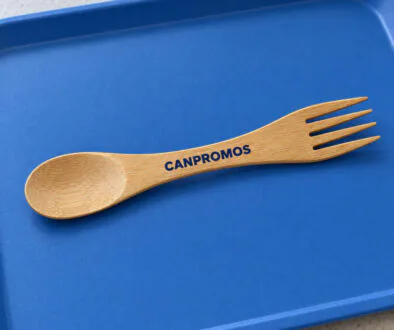
The Custom Nimoy Bamboo Spork combines a spoon and fork in one bamboo utensil. Inspect its handle and fork tips for visible damage, compare the quoted decoration with the approved reference, and pass along the listing’s handwashing recommendation. A visually intact utensil is not a sanitation certification.
The Custom Lucent Acrylic Wireless Charger includes a USB Type-C to USB Type-C cable. Reconcile the cable with the charger and inspect the acrylic for visible damage. No wall adapter is stated as included. Any agreed operational check needs a confirmed compatible device and suitable power supply; it must not become a promise of universal compatibility or charging speed.
Compare delivered branding with the approved reference
Use the final approved reference already attached to this order. Check product identity, logo content, decoration location and any quoted colour or orientation details. If bilingual text was ordered, compare both language versions with that reference rather than correcting wording from memory.
Define the extent of the receiving inspection with the buyer and supplier. There is no universal sampling percentage for every branded merchandise order. A limited check does not prove every piece is defect-free, and an informal office review is not a certification.
Record what was checked, which cartons or units were involved, who checked them, and what was observed. If an exception appears, ask the supplier whether the check should be extended. Do not quietly change the criteria or declare the entire shipment satisfactory from one attractive item.
Hold exceptions and send a factual supplier report
Keep affected goods separate and label their status clearly. Record the SKU, colour, carton identifier, observed quantity, issue and photo filenames. “Gel pen missing from opened set in carton 3” gives the supplier something concrete to investigate.
Notify the supplier promptly and follow the actual order and claims instructions. Retain affected goods and packaging while asking what is required. Canada Post specifically tells receivers of damaged packages or missing contents to contact the sender, retain the goods and original packaging, and take photos immediately. Only the sender can request its investigation. These are Canada Post instructions, not rules for every carrier. 2
Avoid promising a refund, replacement or fixed resolution date. Keep the supplier’s response with the receiving record, and do not discard or return affected goods before obtaining the relevant instructions. Leave unresolved quantities on hold.
Release only the quantity the record supports
Give the internal owner the reconciled quantity, its inspection status, any relevant care instructions, and the unresolved exception count. Record the person authorizing release and the date. A carton still awaiting review should not be represented as ready for use.
Retain the packing list, count record, photos, supplier correspondence and release decision under the order reference, following your organization’s retention policy. That creates a clear account of arrival without turning receiving into a new product approval exercise.
When requesting a CanPromos quote, include the exact SKU, quantity, colour, decoration and workplace receiving window. Ask for current Canadian stock, artwork timing, production slot, freight and required-in-hands confirmation. A live listing is neither a stock reservation nor a delivery guarantee. The same confirmed details will give your receiver a clear basis for checking the finished shipment.
References